


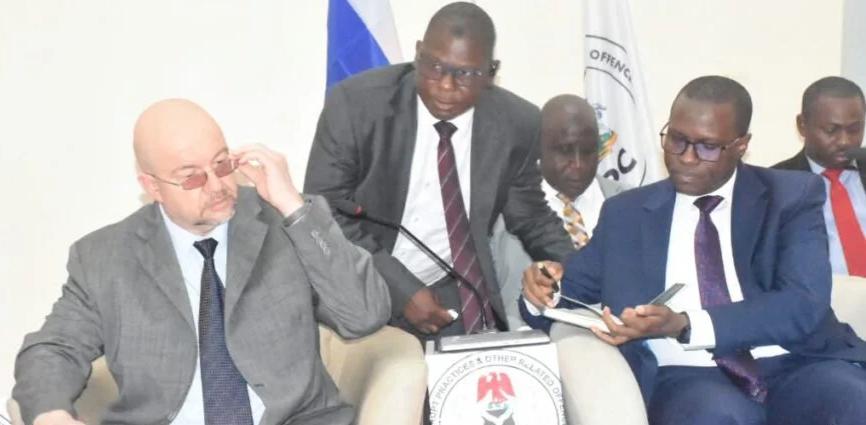
Russia has developed a comprehensive anti-corruption system combining punishment of offenders with prevention of underlying causes, the Chargé d’Affaires of the Russian Embassy in Nigeria, Mr Igor Ivannikov, has said.
Ivannikov said this on Tuesday in Abuja, while delivering a lecture at the 4th Anti-Corruption Academy of Nigeria (ACAN) International Diplomatic Dialogue themed, “Development of Anti-Corruption Strategies and Policies: The Russian National Experience.”
The dialogue, organised by ACAN, the research and training arm of the Independent Corrupt Practices and Other Related Offences Commission (ICPC), aims to share international experiences.
Ivannikov, also the Minister Counsellor at the Embassy, said corruption undermined fair competition and citizens’ trust in government institutions and must be tackled through effective measures.
“Corruption is a major problem for any state. It leads to inefficient use of resources, undermines the principles of fair competition, reduces the quality of public administration, and undermines citizens’ trust in government institutions.
“Therefore, modern policy generally combines two areas: suppressing offenses that have already been committed and addressing their underlying causes.
“Over a few decades, Russia has developed a comprehensive anti-corruption system.
“Its evolution can be divided into three stages: the establishment of the first control mechanisms in the 1990s, the creation of a comprehensive legal framework in the late 2000s, and the subsequent improvement of preventive measures and international cooperation.”
Giving insight into his country’s anti-graft efforts, the envoy said Russia’s model emphasised prevention alongside punishment, combining legal, administrative, financial, technological and educational measures.
He said digitalisation and risk-based control were effective tools but must be complemented by strong oversight and accountability to ensure compliance and strengthen anti-corruption measures.
He said following the collapse of the Soviet Union, Russia faced the need to rebuild its public service and oversight systems, while the transition to a market economy created opportunities for abuse.
Ivannikov recalled that Presidential Decree No. 361 of 1992, “On Combating Corruption in the Public Service,” was among the country’s first legal acts addressing corruption.
He said the decree banned public officials from entrepreneurial activity and required declarations of income, property and bank deposits for senior appointments within public service.
He said a major turning point came in 2008 when Federal Law No. 273, “On Combating Corruption,” was adopted, bringing together preventive measures and requirements for public officials.
According to him, the law also established rules for resolving conflicts of interest and introduced control mechanisms designed to strengthen accountability within public institutions.
On enforcement, he said Russian practice provided a clear division of responsibilities, with detection carried out by the Ministry of Internal Affairs and Federal Security Service.
He said investigations were handled by the Investigative Committee, while the Prosecutor’s Office exercised supervision and represented the state in court.
The envoy explained that offences were defined under the Criminal Code, including accepting a bribe under Article 290, giving a bribe under Article 291 and mediation under Article 291.1.
He said other offences included abuse of official powers under Article 285 and commercial bribery under Article 204, with liability depending on the amount involved.
He said investigators traced the movement of funds and property acquired with illicit money, which could be frozen and transferred to state ownership where legally established.
He added that international legal assistance was used when illicit assets were located abroad, supporting efforts to trace, freeze and recover proceeds of corruption.
On prevention, Ivannikov said Russia focused on declarations of income, property and expenditure monitoring, alongside measures aimed at identifying unexplained wealth and conflicts of interest.
He cited a 2026 case in the Republic of Buryatia where prosecutors recovered more than RUB4 million, about N60 million, transferred to a former minister.
He said other instruments included prevention of conflicts of interest, anti-corruption reviews of regulatory acts and digitalisation of public procurement through the Unified Information System.
The diplomat said every government institution in Russia had an anti-corruption department responsible for monitoring compliance, appointing responsible officials and adopting codes of ethics.
On prospects for cooperation with Nigeria, he said both countries already had national systems and did not need parallel structures, but could strengthen professional collaboration.
He said both countries could benefit from direct professional contacts in financial investigations, asset recovery, monitoring officials’ income and procurement risk assessment.
He said that Russia had a practical approach to international asset recovery through the Prosecutor General’s Office, providing a framework for cooperation with other jurisdictions.
According to him, a legal basis for cooperation existed, as both countries signed a Treaty on Mutual Legal Assistance in Criminal Matters in 2018, ratified by Russia.
He listed possible partners as the University of the Prosecutor’s Office of the Russian Federation, Rosfinmonitoring, Ministry of Internal Affairs and specialised educational institutions.
In his welcome address, the ICPC Chairman, Dr Musa Aliyu, SAN, said Nigeria was seeking to learn from Russia’s anti-corruption strategies and policies to strengthen its own efforts.
Aliyu described Russia as a longstanding friend of Nigeria, noting that bilateral relations between both countries had developed over the years through various areas.
According to him, agreements on air communication, economic, scientific and technical cooperation and trade, among others, had been signed under Nigeria-Russia bilateral relations.
Aliyu said that the commission had earlier hosted three successful Diplomatic Dialogues with Kenya, Indonesia and China in June and August to share experiences on anti-corruption efforts.
He said as Nigeria continued to deepen its anti-corruption efforts, there was value in learning from comparative experiences and identifying innovative approaches adaptable to local realities.
“This dialogue reflects the commitment of ICPC and ACAN to fostering international cooperation and promoting evidence-based approaches to corruption prevention,” he said.
He commended the Provost of ACAN, Prof. Sheriff Ibrahim, and his team for conceptualising the initiative, saying the Academy played a critical role in research, training and capacity development.
The Provost of ACAN, in his remarks, provided historical and contextual background on Russia’s engagement with corruption and injustice, highlighting developments in its anti-corruption framework.
Ibrahim referenced the 1917 Bolshevik Revolution as an early example of Russia’s fight against corruption and inefficiency within the Tsarist regime, linking historical developments to institutional reforms.
He said Russia’s role in establishing the International Anti-Corruption Academy (IACA), while highlighting its contributions to international anti-corruption cooperation and capacity development.
Ibrahim said Russia had a long historical tradition of resisting corruption and external aggression, emphasising that its anti-corruption legal and institutional framework was comprehensive and multi-layered.(NAN)