


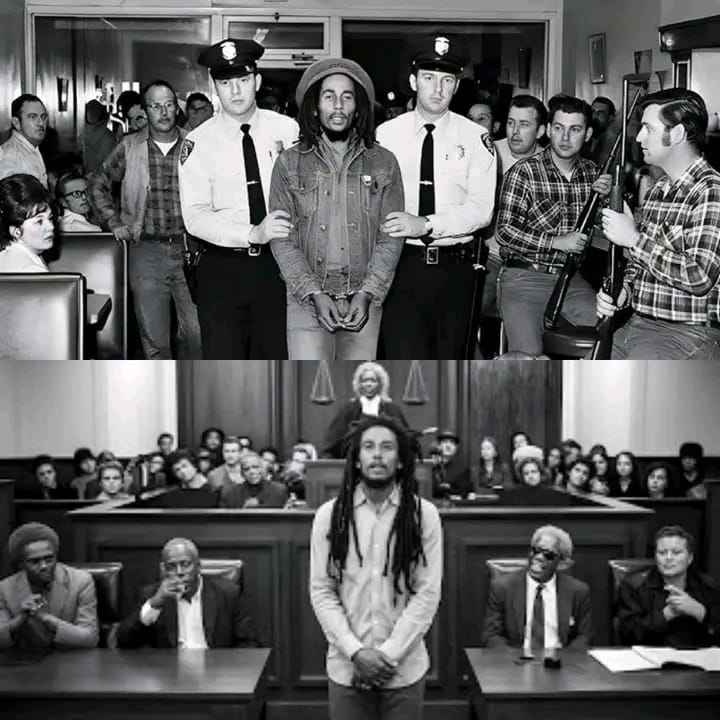
Kingston, Jamaica, February 23rd, 1979. 9 a.m. Bob Marley sat in the defendant’s chair at the Supreme Court of Jamaica, facing charges that could have ended his career forever. The man who had brought peace to waring political factions, whose music had spread love across the globe, was being accused of inciting public disorder through sedicious musical content.
The prosecutor, Attorney General Harold Morrison, stood before Judge Patricia Williams with a stack of Bob’s lyrics, ready to prove that reggae music was a threat to Jamaican society.
What would happen over the next 3 hours would become one of the most extraordinary moments in legal history and change how the world viewed the relationship between music and freedom. 3 weeks earlier, January 30th, 1979, the trouble had started during a concert at National Stadium. Bob had performed Get Up, Stand Up and dedicated it to the people suffering under political oppression.
The crowd had responded with such passion that some politicians became nervous when Bob sang the lines, “Get up, stand up, stand up for your rights. Get up, stand up, don’t give up the fight.” 15,000 people had stood as one, raising their fists, demanding change. It was a moment of unity that transcended political parties, but it terrified those in power.
The next day, member of Parliament Charles Davidson filed a complaint with the Attorney General’s office. This man is using music to incite revolution. Davidson argued his lyrics are sedicious. He’s teaching young people to rebel against authority, to challenge the government, to disrupt social order. This isn’t entertainment.
It’s political manipulation disguised as art. Within a week, Bob Marley was served with an arrest warrant. February 23rd, 9 CABUM, Supreme Court. Judge Patricia Williams looked down at Bob from her bench. She was 52 years old, known for her strict interpretation of the law and had little patience for what she considered disruption of social order.
Attorney General Morrison began his opening statement. Your honor, the defendant, Robert Marley, has used his platform as a musician to undermine respect for authority and incite citizens to rebel against lawful government. His songs contain dangerous messages that encourage young people to stand up against authority, to fight the system, and to reject the social structures that maintain order in our society.
Morrison held up printed lyrics. In his song Burnon and Luton, Mr. Marley sings about burning and looting. In I Shot the Sheriff, he promotes violence against law enforcement. In Get Up, Stand Up, he explicitly calls for resistance against authority. Judge Williams listened intently. As Morrison continued, “Music has power, your honor.
When someone with Mr. Marley’s influence tells thousands of young people to get up, stand up, fight. Those words have consequences. We’ve seen increased protests, civil disobedience, and disrespect for authority since his music gained popularity. Bob’s attorney, David Chen, stood to respond. Your honor, Mr.
Marley’s music promotes love, unity, and social justice, not violence. His lyrics speak about fighting oppression, not fighting people. There’s a difference between encouraging people to stand up for their rights and encouraging them to break the law. Judge Williams looked at Bob, who had remained silent throughout the proceedings. Mr.
Marley, do you understand that if convicted, you could face up to 5 years in prison and be banned from performing in Jamaica? Bob stood slowly. Yes, your honor, I understand. How do you plead to the charges of inciting public disorder through sedicious musical content? Bob’s voice was calm, but clear. Not guilty, your honor. 10:30 a.m. Prosecution witnesses.
Morrison called several witnesses to testify about the dangerous effects of Bob’s music. Police Commissioner Frank Thompson testified. Since Mr. Marley’s music became popular, we’ve seen increased protests and demonstrations. Young people are more defiant, more likely to challenge police authority. His concerts often result in crowds that are difficult to control.
School principal Margaret Foster testified. Students come to school singing Mr. Marley’s songs about fighting and revolution. They question authority, challenge teachers, refuse to follow rules. His music is making our children ungovernable. MP Charles Davidson testified. Mr. Marley’s concerts are political rallies disguised as entertainment.
He uses music to spread anti-government propaganda to turn citizens against their elected leaders. This is sedition, pure and simple. 11:45 a.m. Defense witnesses David Chen called Dr. Marcus Reed, professor of sociology at the University of the West Indies. Dr. Reed, in your professional opinion, does Mr.
Marley’s music incite violence? Quite the opposite, Dr. Reed testified. Mr. Marley’s music has actually reduced violence in Jamaica. Before his one love concert, political violence was tearing this country apart. His music brought waring factions together. He’s prevented more violence than he’s ever caused. Chen called several more witnesses, community leaders, social workers, young people, all testifying that Bob’s music had inspired them to work for positive change through peaceful means.
But Judge Williams seemed unconvinced. What she needed was to understand Bob Marley himself. Whine to his PM. Bob takes the stand. Mr. Marley, Judge Williams said, “I want to hear from you directly. The prosecution claims your music encourages people to break the law. How do you respond?” Bob looked directly at the judge.
Your honor, my music comes from Ja, from God. It speaks about love, about unity, about people standing up for what’s right. When I sing get up, stand up, I’m not telling people to break the law. I’m telling them to demand justice when the law is unjust. Can you explain the difference? Bob thought carefully. Your honor, if a law says that black people can’t vote, should people obey that law? If a law says that poor people can’t get medical care, should people accept that? Sometimes standing up for what’s right means challenging what’s wrong, but
always through love, never through hate. Morrison interrupted. But Mr. Marley, your song, I Shot the Sheriff clearly promotes violence against police officers. Bob smiled sadly. Mr. Morrison, that song is not about killing policemen. It’s a metaphor about defending yourself against oppression. The sheriff represents any force that tries to keep people down.
And even in the song, I say, “But I did not shoot the deputy, meaning I only fought back when I had to.” Judge Williams leaned forward. Mr. Marley, when you perform these songs, what do you want your audience to do? I want them to love themselves, your honor. I want them to love each other. I want them to work for justice, but through peace.
I want them to stand up for their rights, but through unity, not division. But your lyrics can be interpreted as calls to revolution. Bob nodded. Yes, your honor, they can. Because sometimes we need revolution, but not the kind with guns and violence. We need revolution of the heart. Revolution of the spirit. Revolution that changes how people think and feel.
Judge Williams was quiet for a long moment. Mr. Marley, I want to ask you something directly. If I rule that you cannot perform music with political messages, will you comply? Bob looked at the judge, then at the crowd of supporters who had packed the courtroom. Your honor, Bob said quietly. I would respect the court’s decision, but I would also have to follow my conscience.
If Jah calls me to make music, I have to make music. If the people need to hear messages of love and justice, I have to share those messages. I would rather go to prison for speaking truth than be free for staying silent. 2:30 p.m. The judge’s decision. After closing arguments, Judge Williams announced a recess to consider her verdict.
When court reconvened, she looked tired. She had spent 30 minutes alone, wrestling with a decision that would [clears throat] affect not just Bob Marley, but the future of artistic freedom in Jamaica. Mr. Marley, she began, please stand. Bob stood, prepared for whatever came next. I have listened carefully to all testimony.
I have reviewed your lyrics extensively. I have considered the law and I have considered justice. The courtroom held its breath. Mr. Marley, I want you to do something for this court. I want you to perform one of the songs that the prosecution claims is sedicious. I want to hear for myself what you’re really saying. Bob was stunned.
Your honor, you heard me correctly. I want you to sing redemption song for this court right now. Morrison jumped up. Your honor, this is highly irregular. This is a courtroom, not a concert hall. Judge Williams looked at Morrison firmly. Mr. Morrison, you’ve spent hours telling me how dangerous Mr. Marley’s music is. Now I want to hear it for myself. Mr.
Marley, proceed. Bob began to sing a capella, his voice filling the formal courtroom. Old pirates, yes, they rob I sold I to the merchant ships minutes after they took eye from the bottomless pit. The effect was immediate and powerful. Bob’s voice transformed the courtroom from a place of judgment into a place of truthtelling.
But my hand was made strong by the hand of the Almighty. We forward in this generation triumphantly. Judge Williams watched Bob’s face as he sang, saw the passion, the sincerity, the deep spirituality in his expression. This wasn’t the face of someone trying to incite violence. This was the face of someone sharing his soul.
Won’t you help to sing these songs of freedom? cuz all I ever have redemption songs. When Bob finished, the courtroom was completely silent. Several people in the gallery were crying. Even some court officers had tears in their eyes. Judge Williams wiped her own eyes before speaking. Mr.
Marley, in 30 years as a judge, I have never
asked a defendant to perform in my courtroom, but I needed to hear your music with my own ears, not filtered through lawyers interpretations. She paused, composing herself. What I heard was not sedition. What I heard was pain transformed into hope. What I heard was a man singing about freedom.
Not freedom from law, but freedom from injustice. What I heard was truth. Judge Williams looked at the prosecution table. Mr. Morrison, you argued that Mr. Marley’s music is dangerous because it encourages people to stand up for their rights. But in a democracy, standing up for one’s rights is not sedition. It’s citizenship. She turned back to Bob. Mr.
Marley, I find you not guilty of all charges. The courtroom erupted in cheers. Bob’s supporters jumped to their feet, crying and embracing. Judge Williams smiled. The first time anyone had ever seen her smile in court. Mr. Marley, I want to say something to you. Music does have power. Your music has tremendous power.
With that power comes responsibility. I trust that you will continue to use your gift to promote justice through peace, love through understanding, and change through unity. Bob nodded solemnly. Yes, your honor, I will. Then this case is dismissed. Court is adjourned. The aftermath. The case became landmark precedent for artistic freedom in Jamaica and throughout the Caribbean.
The Marley decision established that music expressing political views was protected speech as long as it didn’t explicitly call for violence. Judge Patricia Williams later said in interviews, “When Bob Marley sang in my courtroom, I realized that I wasn’t just judging a man. I was judging the voice of an entire people.
How could I silence hope? How could I criminalize truth? N0. Bob Marley never forgot the experience. In concerts afterward, he would often tell audiences they tried to put I in prison for singing about freedom. But freedom can’t be imprisoned. Truth can’t be criminalized. Love can’t be outlawed.? Today, the courtroom where the trial took place displays a plaque with lyrics from redemption song.
“Emancipate yourselves from mental slavery. None but ourselves can free our minds.”